
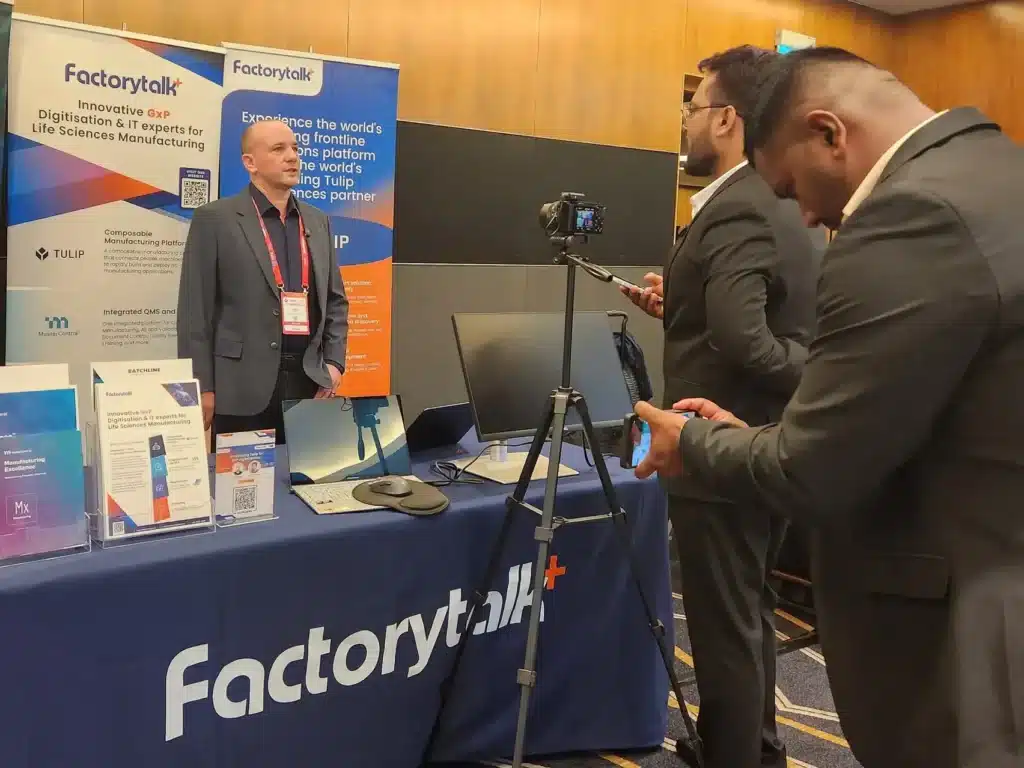
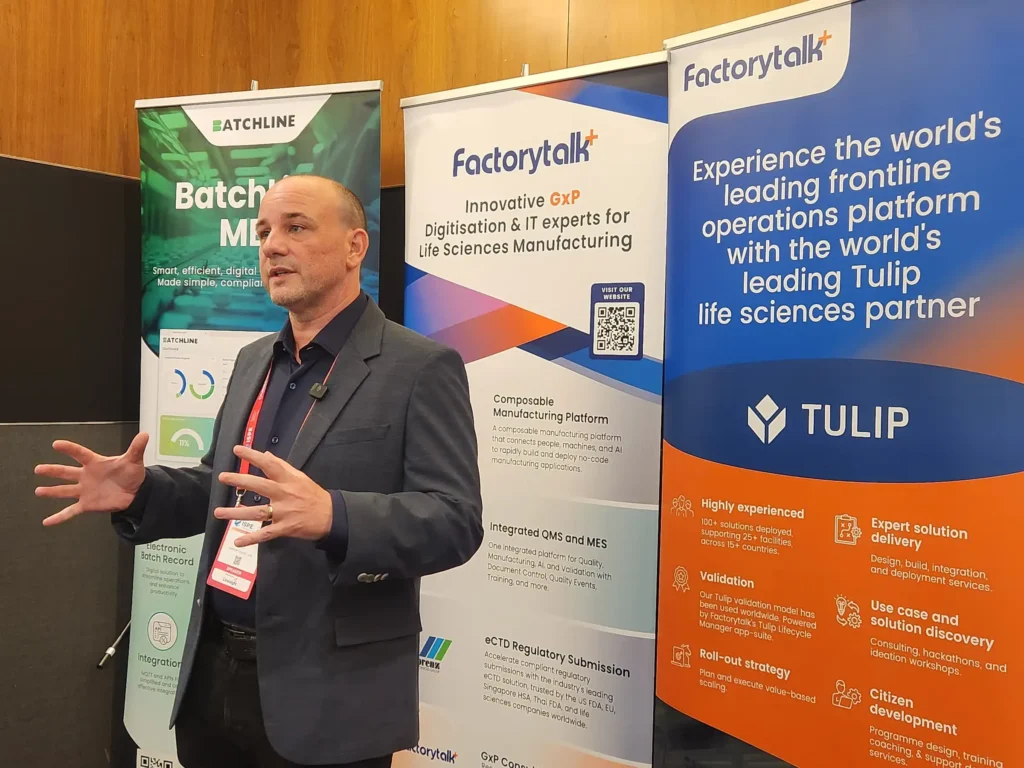
Factorytalk’s David Holt, Group Executive Director, was recently featured in an Executive Video Bite interview with Pharma Focus Asia during ISPE Singapore 2026.
In the interview, David discusses some of the most important trends shaping digital transformation in pharmaceutical and life sciences manufacturing today, including the move towards platform-based architectures, cloud technologies, composable manufacturing, and the rapidly evolving role of artificial intelligence.
1. What are the key digital transformation trends in pharmaceutical manufacturing today?
David highlighted a continued shift from individual point solutions towards integrated digital platforms, particularly among global pharmaceutical companies seeking to simplify their technology landscape and standardise solutions across multiple sites.
Key trends include:
- Platform over point solutions:
Fewer, more scalable platforms supporting multiple manufacturing use cases.
- Cloud adoption:
Continued migration from traditional on-premise systems towards cloud-based technologies.
- Composable digitalisation:
Using interconnected applications and shared data rather than relying on large, rigid standalone systems.
- More mature AI adoption:
Moving beyond experimentation and isolated proofs of concept towards practical, value-driven AI use cases.
- Stronger AI governance:
Greater focus on data residency, security, approved AI tools, and how organisational data is shared with third-party AI services.
Moving towards connected platforms, cloud, composability, and more mature AI adoption.
2. What are the biggest challenges when implementing digital manufacturing solutions, and how can Factorytalk help?
David identified validation as one of the biggest challenges slowing the adoption of modern manufacturing technologies. However, the problem is often not validation itself, but outdated validation processes, procedures, and SOPs that were designed around older technologies.
As technology becomes more agile and applications are updated more frequently, manufacturers need validation approaches that can support this speed of change while maintaining the appropriate level of control and regulatory compliance.
Factorytalk helps organisations assess and modernise their validation approach, ensuring that governance, testing, procedures, and lifecycle processes are fit for modern digital technologies.
Validation should enable digital transformation, not become a barrier to it.
3. What are the key takeaways from your session on composable digitalization: MES & AI Authoring in Manufacturing?
David shared a real-world project delivered with Tulip and a Factorytalk customer, demonstrating how a comprehensive MES can be built using a composable approach.
The solution consists of approximately 38 interconnected no-code applications, rather than one large monolithic system, with capabilities and integrations including:
- Electronic Batch Records (EBR)
- Review by exception
- Digital logbooks
- SAP integration
- Weighing-scale integration
- Connected manufacturing workflows
- Validated GxP applications
The project addresses a question manufacturer has asked for several years: Can a composable, no-code platform really support complex MES and EBR requirements?
David’s answer is clear: yes, and it is already being done in real manufacturing environments.
He also highlighted how AI can support application authoring and validation, such as drafting apps and validation scripts, while experienced professionals retain oversight and accountability.
Composable manufacturing applications can now support sophisticated,
full-scope MES requirements.
4. What advice would you give life sciences companies looking to accelerate digital transformation?
To accelerate transformation, manufacturers need to look at the entire environment that enables technology to be deployed and scaled successfully.
David highlights several critical foundations: modern validation processes, the right technology architecture, effective integration and middleware, and appropriate internal IT support models.
Legacy integration approaches and outdated processes can significantly slow transformation, even when modern technology is available.
The goal is therefore to establish the right foundations around technology so that new solutions can move more quickly from deployment into validated operational use.
Pharmaceutical digital transformation is moving towards more flexible, connected, and composable technologies—but technology alone is not enough. Success depends on creating the right validation, governance, architecture, integration, and support framework to deploy these technologies quickly, compliantly, and at scale.
Explore Digital Manufacturing with Factorytalk
Whether you are beginning with a targeted digital use case or developing a wider MES and digital manufacturing strategy, Factorytalk can help you identify the right technology, delivery model, validation approach, and roadmap for your organisation.