
How can life sciences manufacturers move beyond paper, spreadsheets and rigid legacy systems while maintaining the control required for GxP operations?
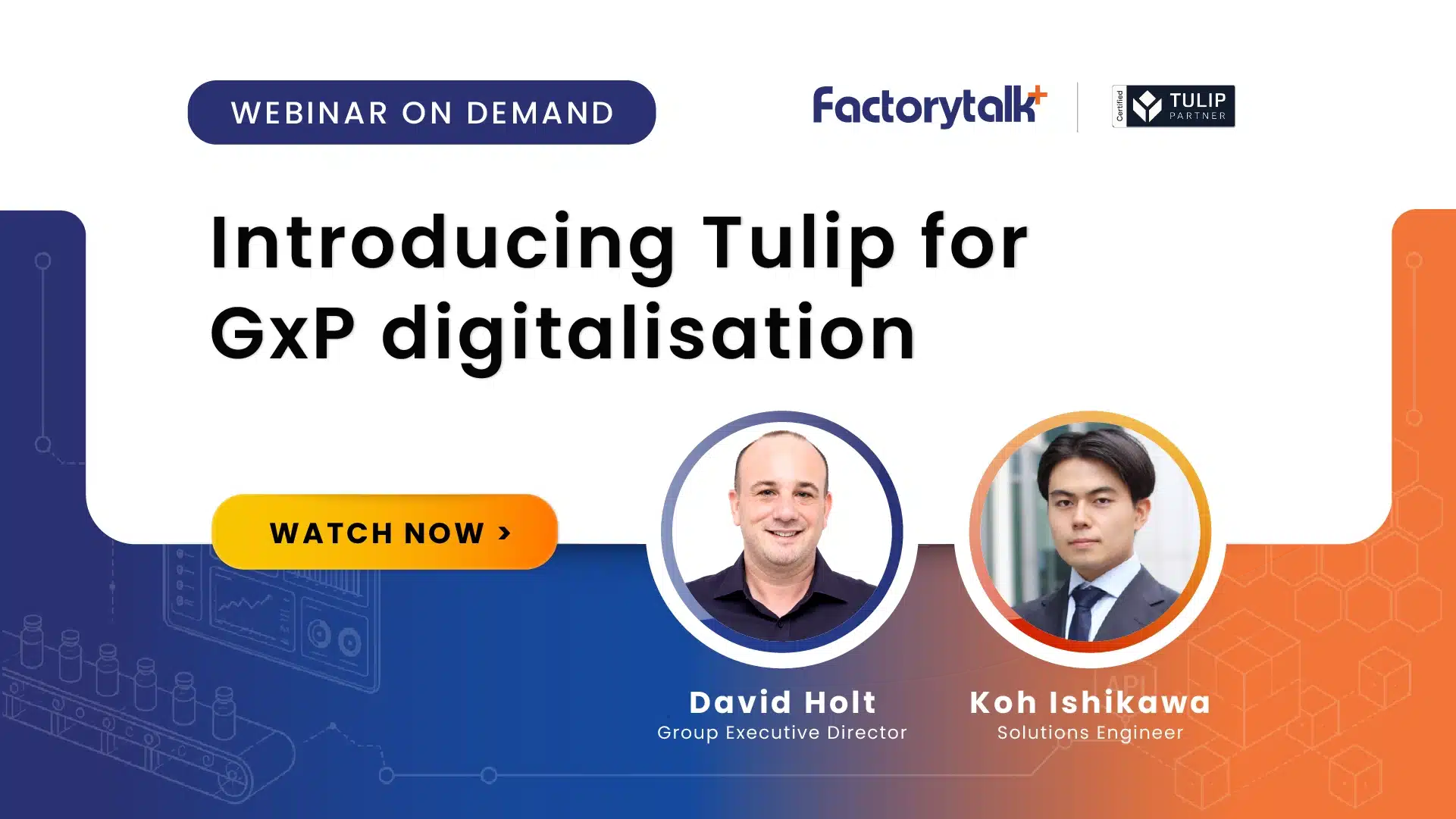
Factorytalk hosted the webinar “Introducing Tulip for GxP Digitalisation,” exploring how a composable, no-code approach can help pharmaceutical and life sciences manufacturers digitalise manufacturing operations while maintaining appropriate governance and validation.
Presented by David Holt, Group Executive Director at Factorytalk, and Koh Ishikawa, Solutions Engineer, the session explored composable manufacturing, practical GxP use cases, implementation strategies, governance, validation and Tulip applications in action.
Why life sciences manufacturing needs a more flexible approach to digitalisation
What is Tulip for GxP digitalisation?
Traditional manufacturing software projects can require organisations to define a large scope upfront, followed by lengthy implementation before operational value is realised.
Composable digital manufacturing offers a different approach.
Instead of relying on one large, fixed system, manufacturing software can be built from smaller, connected applications on a shared platform. Applications can address specific operational processes while remaining reusable and scalable across the organisation.
This allows manufacturers to start with high-value operational challenges, demonstrate value and progressively expand their digital capabilities.
Tulip is a no-code and composable manufacturing platform that enables organisations to build applications around their operational processes. Its visual development environment allows applications to be configured without traditional software coding, while its cloud-native architecture supports scalability.
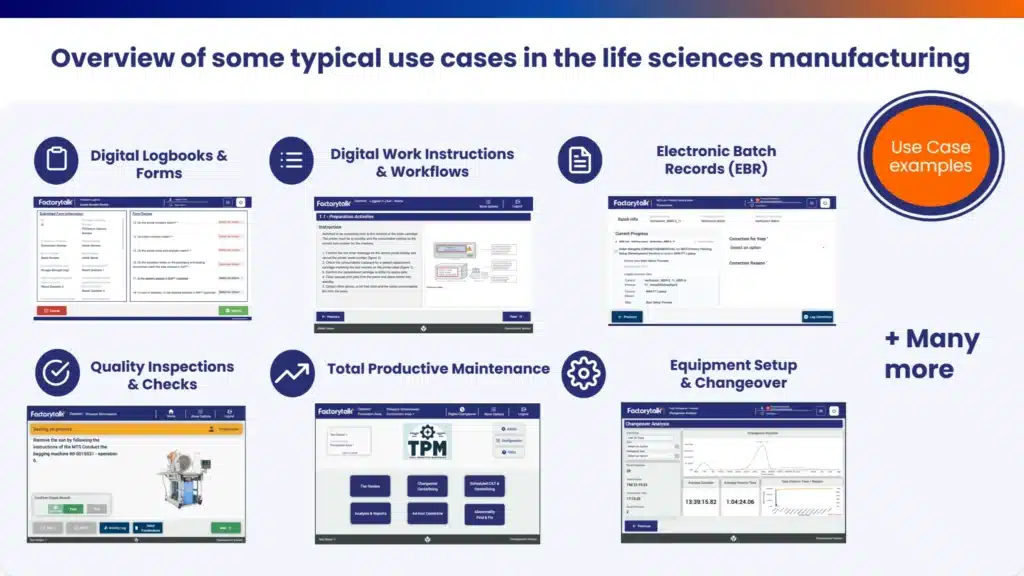
For life sciences manufacturers, Tulip can support connected applications across areas including digital forms and logbooks, work instructions, equipment operations, changeover, electronic batch records (EBR), MES, quality, maintenance and more.
One platform. Many connected manufacturing applications.
Start with the right GxP use case
Applying risk-based validation to Tulip
Digital transformation does not always need to begin with a large-scale MES implementation.
Manufacturers can start by identifying a specific operational challenge where digitalisation can create measurable value—for example replacing paper logbooks, digitising work instructions, improving equipment changeovers or introducing electronic batch records.
Validation is another critical part of deploying applications within GxP environments.
Rather than applying the same validation effort to every application, organisations can adopt a risk-based validation approach, scaling activities according to application complexity, GxP impact and risk.
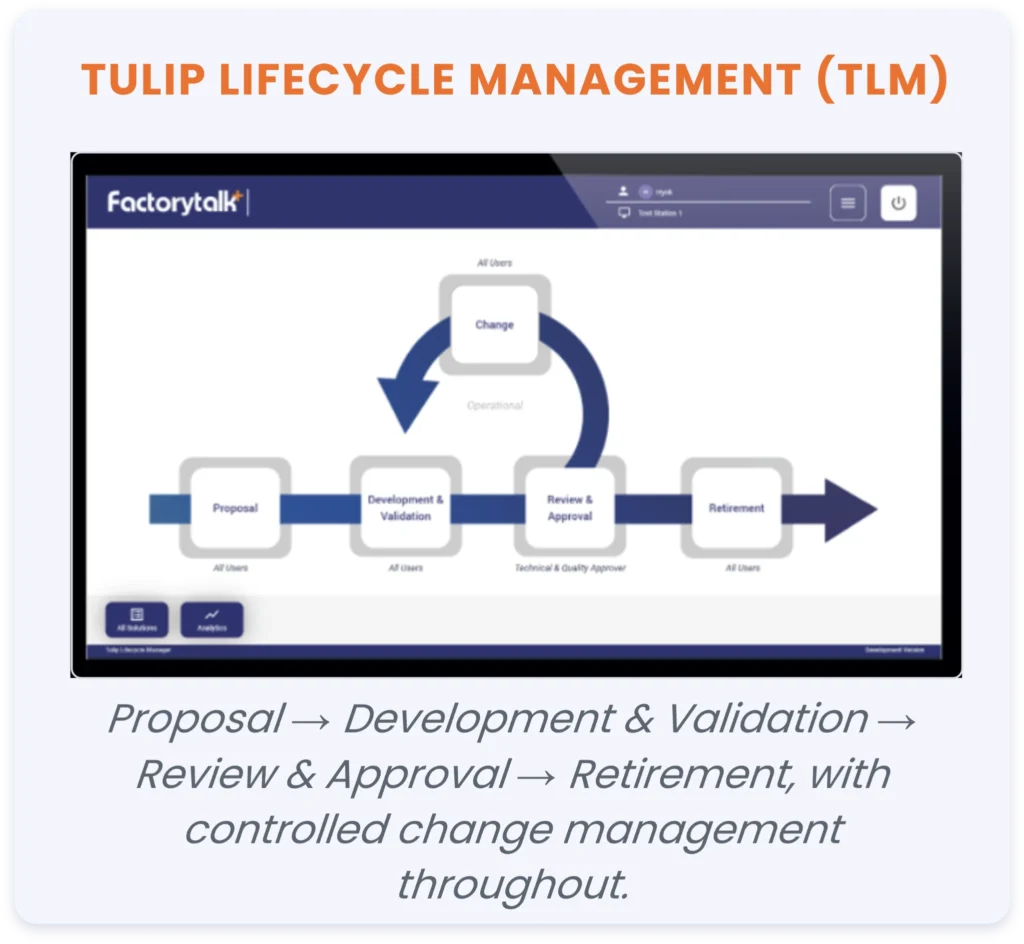
Factorytalk’s Tulip Lifecycle Manager (TLM) supports application development, validation, review, approval, release and controlled change management throughout the application lifecycle.
This approach helps maintain compliance while enabling digital applications to be developed and deployed efficiently.
From one application to digital manufacturing at scale
Supporting your GxP digitalisation journey
The value of composable digitalisation increases as successful applications are reused and scaled.
Factorytalk has delivered hundreds of Tulip solutions, with more than seven full MES/EBR deployments live, Factorytalk-built solutions and Citizen Developer teams operating across 34 sites, and Tulip Lifecycle Manager being used across 14 countries.
As a Tulip life sciences partner since 2018, Factorytalk combines Tulip platform expertise with extensive experience in regulated manufacturing.
Our capabilities cover solution delivery, GxP validation, integrations, customer enablement, strategic consulting, governance and ongoing support—helping manufacturers move from initial use-case identification through implementation and scale.
Missed the webinar?
Watch the on-demand “Introducing Tulip for GxP Digitalisation” webinar to explore how composable manufacturing, no-code applications and risk-based validation can support your digital manufacturing journey.