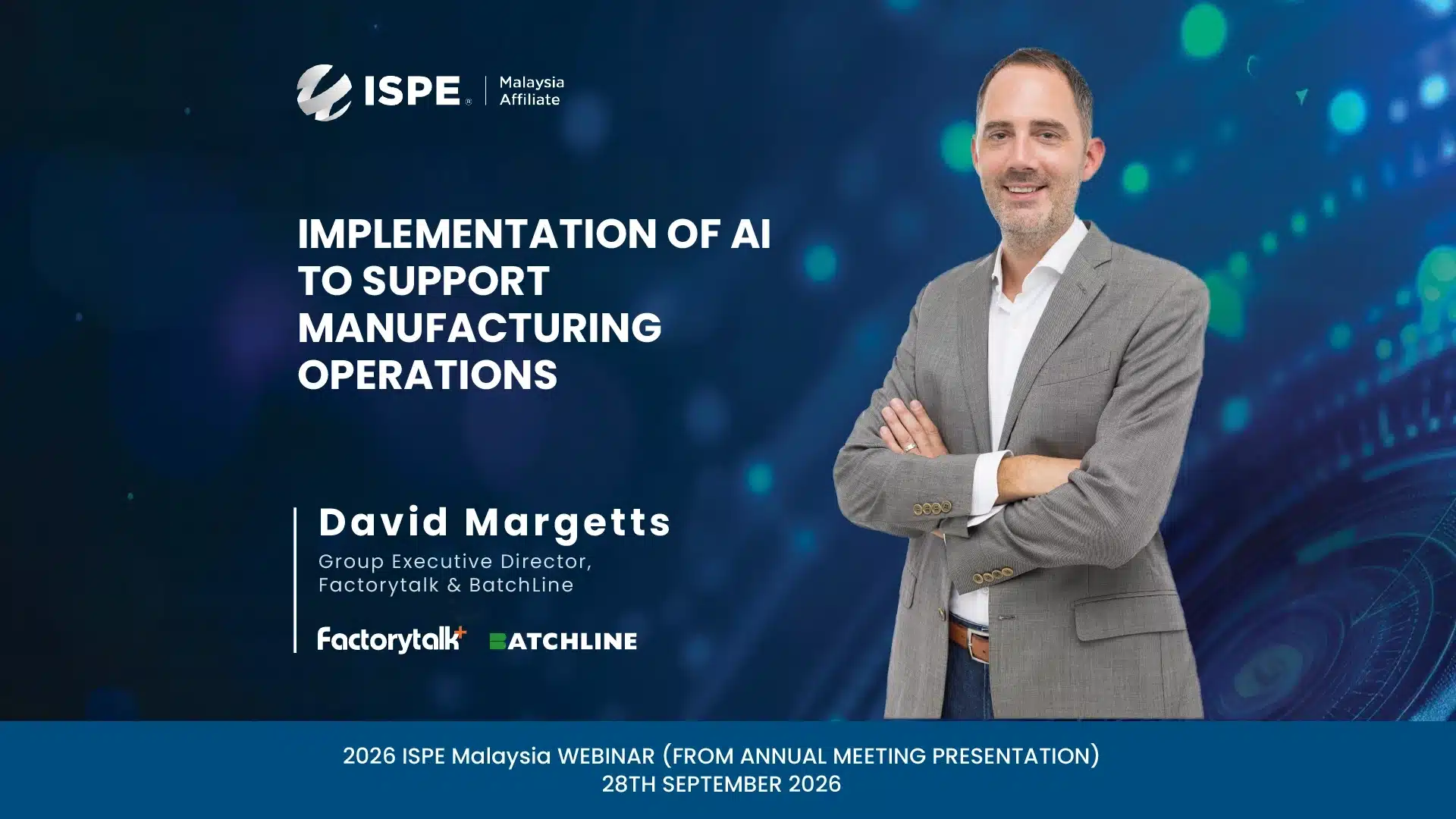

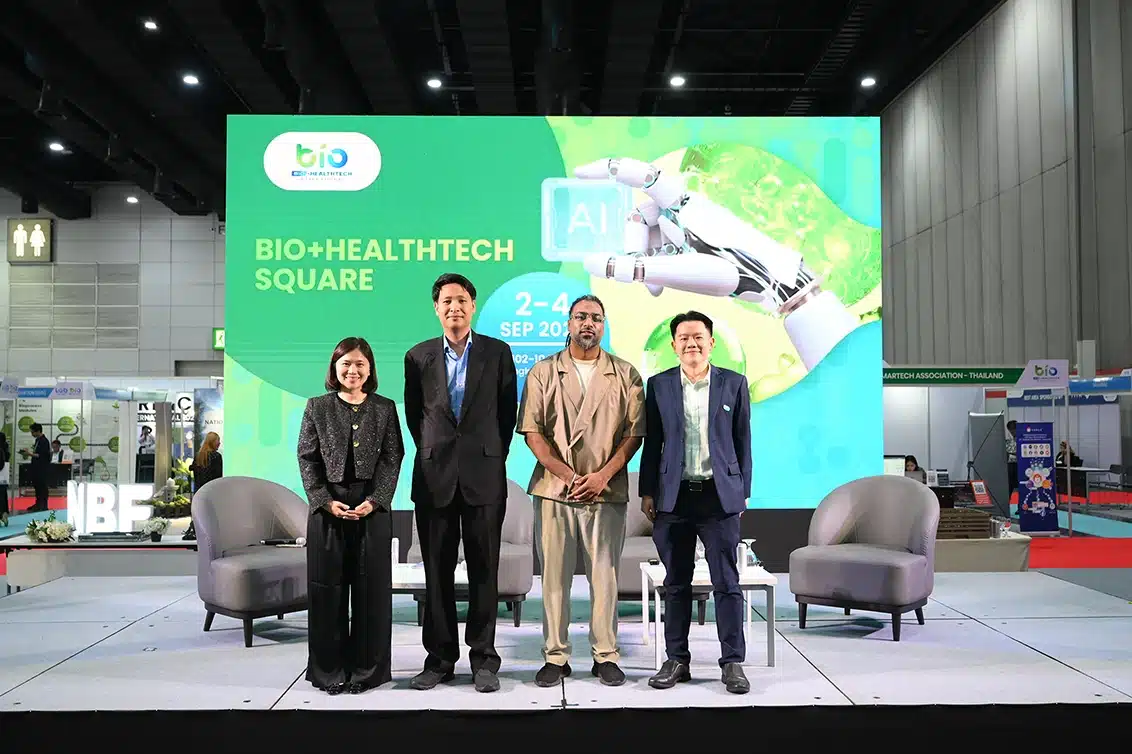
Teerapong Cheepchol, Managing Director, Thailand at Factorytalk, joined BIO+HealthTech International 2026 to discuss what it will take for Thailand and ASEAN to scale biologics manufacturing, strengthen regulatory confidence, and accelerate digital manufacturing maturity.
At BIO+HealthTech International 2026, Teerapong joined the panel discussion “Scaling the Frontier: Vaccines, Biologics, Organoids, and the Future of Life Sciences Manufacturing” on 3 September at BITEC Bangna, Bangkok.
The discussion brought together perspectives across regulation, manufacturing and technology to explore how Thailand and ASEAN can strengthen their position as competitive biomanufacturing hubs.
For Teerapong, the opportunity is clear: Thailand has already proven that it has the technical capability. The next challenge is transferring knowledge, building regulatory confidence, and scaling successful projects into repeatable standards across the industry.
People and process knowledge come before equipment
When biologics move from development to commercial-scale manufacturing, the biggest constraint is not necessarily equipment.
Teerapong ranks the major scale-up challenges as people first, analytics second, data systems third, and equipment fourth. While manufacturing equipment can be specified, purchased and qualified, transferring process knowledge across development, production, QA, QC and engineering is considerably more difficult.
For successful scale-up, teams need to understand which process conditions genuinely affect product quality. Strong analytical methods are equally important to distinguish genuine process changes from testing variability, while connected data systems help manufacturers identify process drift and support continued process verification.
ASEAN is moving from regulatory alignment to regulatory confidence
The regulatory environment for regional biopharmaceutical manufacturing is also evolving.
The ASEAN GMP mutual-recognition framework was expanded in June 2025 to include finished biopharmaceutical products and their active pharmaceutical ingredients, with Member States given up to five years to implement the changes.
For Teerapong, this means the remaining challenge is increasingly operational rather than purely legal.
Greater mutual recognition requires comparable quality systems, experienced inspectors, transparent reporting and mechanisms for regulators to clarify or challenge inspection findings. This becomes particularly important for biologics, where manufacturing processes and associated risks are inherently complex.
Faster analytical methods: Quality before speed
Teerapong highlighted that adopting a faster alternative analytical method should be driven by quality and regulatory confidence, not speed alone. Manufacturers must first follow the appropriate regulatory pathway and demonstrate that the new method delivers the same or better quality decisions than the existing method.
This requires strong evidence, including risk assessment, validation, method comparison, data integrity, analyst training, change control and ongoing monitoring. Ultimately, inspectors need to see a method that is regulator-aligned, validated, controlled and consistently applied.

Digital manufacturing must be designed in, not added later
Thailand has already demonstrated that advanced pharmaceutical digitalisation can be delivered locally.
Factorytalk’s work at GPO Rangsit in 2015 demonstrated an early pharmaceutical Electronic Batch Record (EBR) implementation in Thailand, connecting warehouse, production, quality, ERP and laboratory systems. But Teerapong emphasised that implementing an EBR alone does not make a manufacturing site digitally mature.
True digital maturity comes when materials, equipment, laboratory results, deviations and quality decisions form one trusted information flow.
This becomes even more important in biologics and vaccine manufacturing, where the volume and criticality of manufacturing data increase. Rather than introducing digital systems after facilities and equipment have already been established, manufacturers should consider MES, LIMS, quality systems and data governance alongside facility and control-strategy design from the beginning.
Thailand’s challenge is no longer capability; it is scale
Looking across Asia, Teerapong highlighted different strengths across established manufacturing markets. Singapore stands out for new-facility architecture and regulatory alignment; Korea combines significant biologics scale with rapid execution and smart-factory capability; while Japan brings deep engineering and quality expertise.
Thailand, meanwhile, has capable engineers and competitive delivery capabilities. The remaining gap is consistency and scale.
Leading Thai and greenfield manufacturing sites are progressing, but digitalisation across the broader industry remains uneven. Too often, successful solutions remain limited to one production line, process or facility instead of becoming standardised ways of working across the organisation.
The next stage of Thailand’s digital manufacturing journey should therefore be measured not simply by the number of pilot projects launched, but by how many validated solutions become scalable, repeatable standards that improve quality decisions without increasing risk.
From digital manufacturing strategy and GxP compliance to MES, EBR and data integrity, Factorytalk helps life sciences manufacturers turn digital initiatives into scalable, validated solutions.