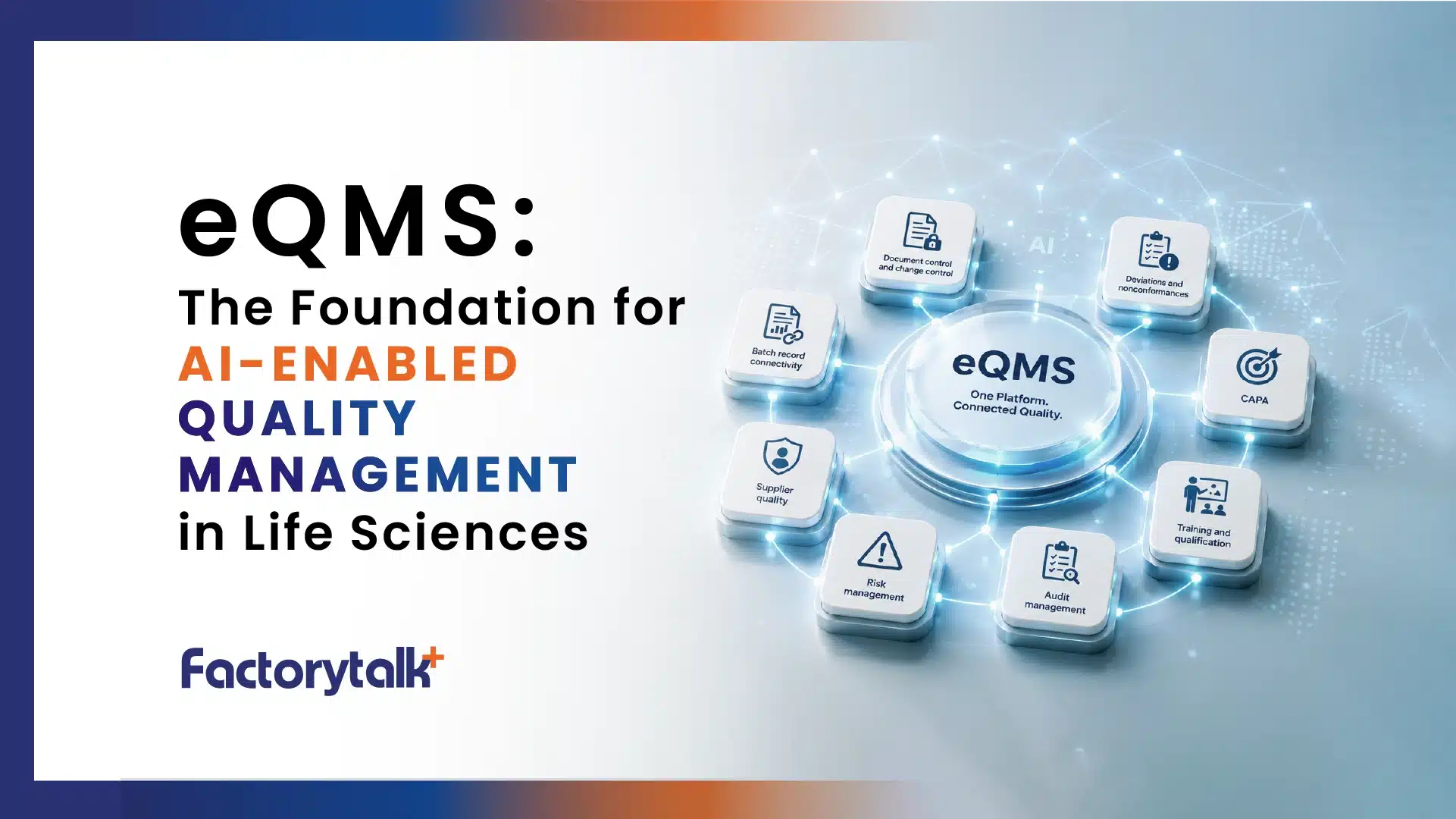

An electronic quality management system (eQMS) manages the full quality lifecycle in a regulated manufacturing environment on one governed platform, replacing disconnected documents and spreadsheets with a single data model covering document control, deviations, CAPA, training, audits, risk, and supplier quality.
A 2025 study of 300 life sciences quality and manufacturing professionals found that 59% consider integrated systems the top prerequisite for AI, ahead of data lakes, clean master data, and workforce readiness combined. For regulated manufacturers, the priority is not choosing an AI model. It is connecting the systems that feed it.
Four tiers of digital maturity
- Manual — paper records, knowledge held by individuals
- Digital — core systems (QMS, MES, ERP) exist but operate in isolation
- Connected — systems integrated via APIs, data unified across sites
- Intelligent — AI/ML running on clean, connected data
A system cannot reach Intelligent without first becoming Connected. In 2025, 56% of organizations are stuck at Digital, 41% are Connected, and 0% report Intelligent operations at scale.
Digitization is not digital transformation
Digitization converts paper to electronic files without changing the process. Digital transformation redesigns the process to be data-centric, with real-time flow across systems. Only transformation produces AI-usable data. Across 18 core processes studied, 55–64% remain hybrid, and none reached fully intelligent.
What disconnection costs
- 97% of quality teams say audits are challenging and time-consuming
- 97% cannot predict quality issues before they occur
- 95% of manufacturing teams report GMP documentation and data integrity issues
- 93% operate disconnected, siloed production systems
eQMS is more than document control
A modern eQMS manages the full quality lifecycle on one governed platform, with one data model, one audit trail, and end-to-end traceability across:
- Document control and change control
Versioning, approvals, periodic review
- Audit management
Internal, supplier, and regulatory audits with finding follow-up
- Deviations and nonconformances
Structured capture, triage, and investigation
- Risk management
Risk registers linked to processes, products, and quality events
- CAPA
root cause analysis, corrective and preventive actions, effectiveness checks
- Supplier quality
Approved vendor lists, supplier events, SCARs, requalification
- Training and qualification
role-based training tied to controlled documents and changes
- Batch record connectivity
Quality events and reviews linked to production context
Closed-loop quality in practice
In a connected eQMS, a deviation references the batch record and equipment involved. The CAPA references the deviation. The change control references the CAPA. The revised SOP triggers training. The effectiveness check closes the loop and feeds trending data. Nothing falls between systems.
eQMS in the manufacturing ecosystem
An eQMS creates the most value when it exchanges data with the systems around it:
- MES/EBR
Deviations raised during execution flow directly into quality events, enabling review by exception
- Equipment/CMMS
calibration and maintenance status become visible inside deviations and batch review
- ERP
Material, lot, and supplier master data stay consistent across quality records
- Training/LMS
document changes automatically drive role-based training assignments
- LIMS/CDS
Out-of-specification and out-of-trend results trigger investigations with full lab context
- Supplier systems
supplier events, certificates, and SCARs link directly to incoming material quality
One concrete example:
An out-of-specification result in LIMS can automatically open an investigation in the eQMS, pre-populated with batch, method, and instrument data.
No re-typing, no lost context. Integration turns quality records into quality intelligence, and the practical guidance is to prioritize a small number of high-value integrations, such as deviations from MES, OOS from LIMS, and training from document changes, rather than attempting everything at once.
Compliance by design
- ALCOA+
Data integrity enforced by the system, not discipline alone
- Role-based access control
And segregation of duties
- 21 CFR Part 11 / EU Annex 11
Audit trails and e-signatures
- Risk-based validation (CSV to CSA),
Rigor where patient risk is real
Common implementation mistakes
1. Digitizing broken processes instead of redesigning them
4. Big-bang scope with thin resources
2. Treating integration as “phase 2 forever”
5. Ignoring change management
3. Underestimating master data consistency
6. One-size-fits-all validation
AI readiness: A journey, not a switch
71% of organizations are still piloting AI;
11% report significant impact today;
51% expect impact only in three to five years.
Integration is both the top AI prerequisite (59%)
And the top barrier (24%),
And roughly half cite cultural resistance to change.
Readiness checklist:
- Core processes digital, standardized, governed in the eQMS
- Master data harmonized across systems and sites
- Key integrations live: eQMS ↔ MES/EBR, ERP, LIMS, training, equipment
- Governance defined: ownership, definitions, quality rules
- Data captured in structured fields, not free text
- Validation strategy explicitly covers intended AI use
The path forward
1. Digitize and standardize core quality processes in a governed eQMS
3. Govern the data with harmonized master data and unbroken audit trails
2. Connect quality, manufacturing, lab, ERP, and training systems
4. Add intelligence through analytics first, then AI, on trusted data
An eQMS is no longer just a quality system. It is the foundation for connected, controlled, AI-ready quality operations. Integration precedes intelligence.
Frequently Asked Questions
An eQMS is software that manages the full quality lifecycle in a regulated manufacturing environment, including document control, deviations, CAPA, training, audits, risk, and supplier quality, on one governed platform with a single audit trail.
Digitization converts paper records into electronic files without changing the underlying process. Digital transformation redesigns the process itself to be data-centric, with real-time data flow across systems. Only transformation produces data that AI can reliably use.
A 2025 industry study of 300 professionals found that 59% consider integrated systems the top prerequisite for AI, more than data lakes, clean master data, and workforce readiness combined. Disconnected systems produce fragmented, incomplete data that makes AI output unreliable.
A modern eQMS typically connects with MES/EBR for production and deviation data, ERP for material and supplier master data, LIMS/CDS for lab results, equipment or CMMS systems for calibration and maintenance status, training or LMS platforms for role-based assignments, and supplier systems for incoming material quality.
Industry data suggests three to five years for most organizations, since building integrated systems, clean master data, and governance ahead of AI cannot be shortcut, particularly where product quality affects patient safety.
The most frequent mistakes are digitizing broken processes instead of redesigning them, delaying integration indefinitely, underestimating master data consistency, attempting a big-bang rollout with limited resources, neglecting change management, and applying one-size-fits-all validation regardless of actual risk.